

Unlocking the realm of artistic expression through technology is something man has continually worked at since art’s inception. Technological innovations have always been evolving the ways we look at expression, and as the boundaries between human creativity and machine innovation blur, we find ourselves standing on the precipice of a new era in the realm of art. Today, we take a behind-the-scenes look at the mesmerizing world of Dulcinea the painting robot, and the remarkable invention that catapults her prowess to unprecedented heights: her articulating wrist. Welcome to the extraordinary world of modern inventor Paul Kirby, Dulcinea, and their captivating brushstroke ballet.
Related: The Challenges of Designing Dulcinea, The Painting Robot
The Soul of Painting
When you look at a great painting, what do you see? The subject, size, composition, style, colors… and maybe the brushwork? Brushstrokes are the very heart of painted works, the window that connects the painter and their audience – and yet they stand as one of the most overlooked and underappreciated elements of painting. What is a Van Gogh or a Monet painting without their distinctive strokes? An impressionist painting is distinguished by its unique brushwork, as is gestural abstraction, as are most movements in the painting world. As renowned American painter David A Leffel told Paul Kirby, the brushstroke is “the heart and soul of painting.”
The Power of a Brushstroke
When Paul set out to learn all that he could in his journey to fuse art with science, he was fortunate enough to take art classes with both David Leffel and Richard Schmid, two of America’s finest painters. Among other invaluable teachings, they imparted upon Paul a profound understanding of the brushstroke’s significance. Every stroke holds the power to convey emotions, capture light, and breathe life onto the canvas. Leffel deconstructed the brushstroke into its three distinct motions – down, over, and up – and Schmid dropped pieces of sage-like advice, such as: “Each stroke requires exquisite deliberation,” and, “Don’t gamble with brushstrokes, you’ll never win.” Paul carefully watched each as they painted and found beautiful, stunning brushwork with no evidence of gambling or dabbling. Every movement of the wrist was made with exquisite deliberation.
Having observed the masters at work, Paul wondered… could a machine do the same?
Read More: The Importance of a Brushstroke
If You Want to Build a Robot That Paints…
…what is it supposed to do?
Paul, an engineer at heart, has always been a big believer in taking things to “first principles” – basic truths and assumptions that serve as the foundation for solving problems. Paul asked basic questions of his proposed painting robot: “If you want to build a robot that paints, what does it look like, and what is it supposed to do?” With his vision for fusing art and science, and due to the tutelage of instructors like David Leffel, Richard Schmid, and Glenn Vilppu, Paul knew his goal: to build a robot capable of creating beautiful, exquisite brushstrokes. Paul wanted to build a robot that evoked “the heart and soul of painting.” To achieve this, Paul would need to find a way to make a wrist that was able to smoothly and accurately do everything the human hand can do.
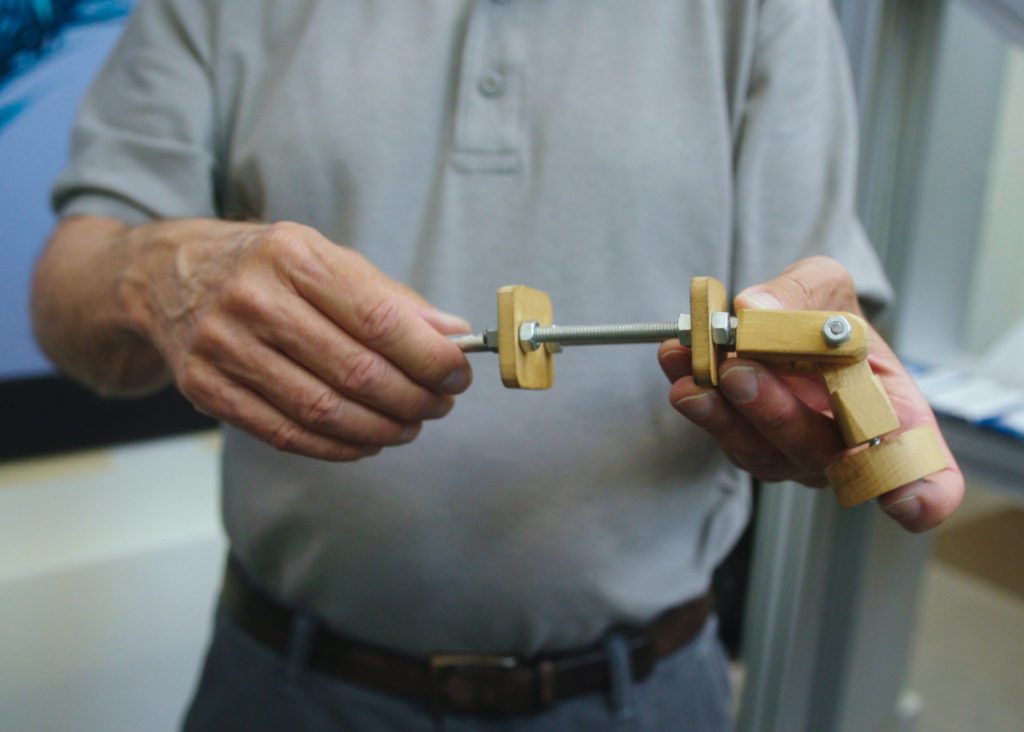
Armed with his awareness and deep appreciation for the brushstroke, Paul set about the task of doing art justice with a robotic hand.
Go Further: How Do Paul and Dulcinea Make a Painting?
The Wrist of a Master Painter
First Attempts
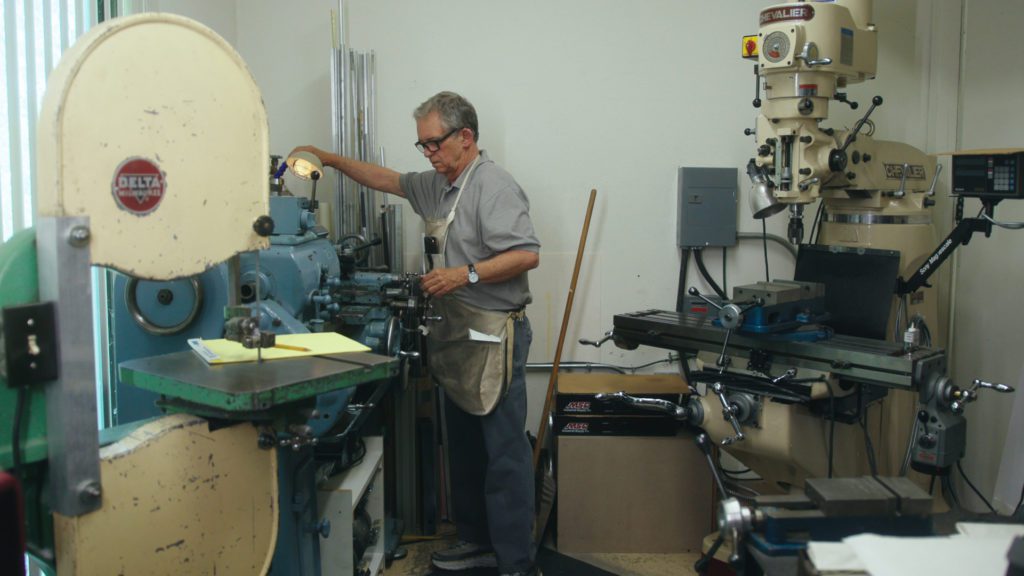
Dulcinea is a gantry-style robot, roughly 10’ tall and 10’ wide, with seven axes of motion. Paul’s first version of Dulcinea’s wrist used standard motors and positioning encoders, which provide the rotational positioning information of the motor back to the controlling computer. Each tick of an encoder represents a small rotational increment of the motor’s drive shaft movement. By knowing the number of ticks produced in a full 360 degree revolution of the motor (e.g. 1000 ticks) and by multiplying that by the motor’s gearing ratio (e.g. 10x) the controlling computer can simultaneously position the load for each motor very precisely throughout the entire orchestrated brushstroke’s movement.
After testing, the wrist with its designed degrees of freedom worked well, but unfortunately the initial motors and positioning encoders lacked the extreme resolution and performance needed for Paul’s envisioned wrist performance.
Success At Last
The wrist’s first iteration fell short of expectations. Undeterred, Paul delved deeper, designing and building a second version using much more expensive motors, zero-backlash gearing and higher resolution encoders. As a result, his state-of-the-art robotic controller could now execute all simultaneous motor motion commands with unrivaled performance, smoothness, and accuracy. Armed with her re-designed new components, Dulcinea’s wrist could now live up to Paul’s dream: the creation of exquisite brushstrokes, the“heart and soul” of painting.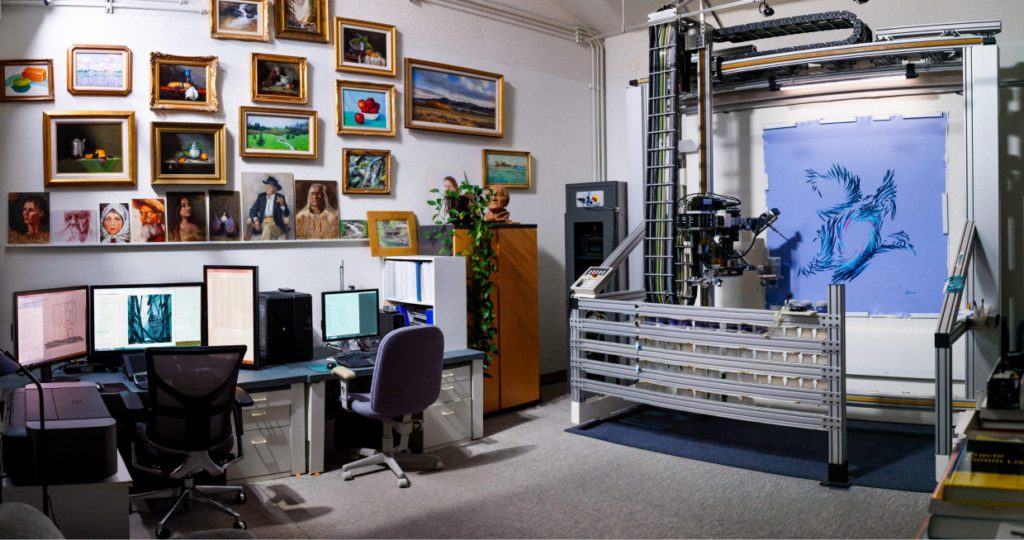
More: See Dulcinea’s Work Speak for Itself
The Perfect Brush for the Perfect Stroke
Dulcinea had used a variety of brushes in her paintings, but Paul had yet to fully capitalize on his robot’s unique wrist capabilities. A human hand has limitations in the way it can rotate, which in-turn informs the ways a human can use a paint brush; robots, however, are not subject to the anatomical limits of the human form.
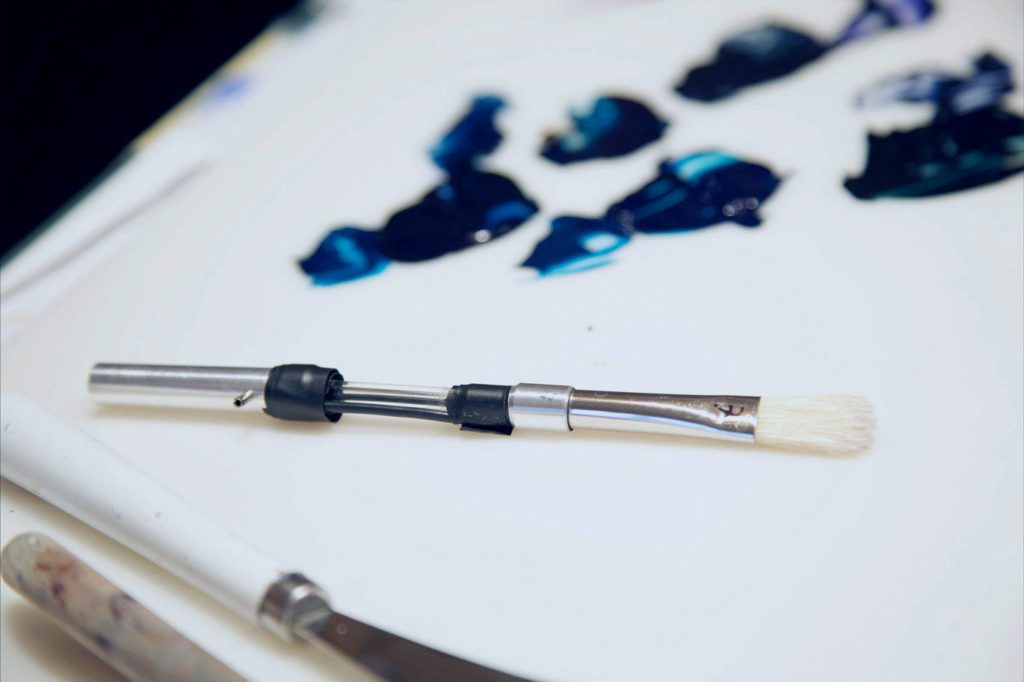
On one of his art study trips with teacher Glenn Vilppu, Paul and his peer group took a four-hour train ride from Stockholm north to Mora, Sweden, to visit the art studio and home of Anders Zorn (1860 – 1920). In his studio, on a table next to his easel, was an old can filled with brushes. Paul was surprised to see that all the brushes were round. “ In all the years I took classes, including teachers and students, not once did I see a round brush,” Paul said. He was used to flat brushes but after experimenting, he found that round brushes could create incredible curving brushstrokes which would later be used to capture powerful, swirling energy in many of Dulcinea’s paintings.
Paul wanted to collaborate with Dulcinea and see what they could do together with a round brush. Initially, the robot’s wrist was configured to roll the brush 180 degrees, just as one might by manipulating their hand and elbow. For a curving brushstroke one could continually roll the brush along the brushstroke’s path while taking paint from the side of the bristles. With fresh paint dipped onto the brush and rolling for 180 degrees, one could deliver a certain length of stroke before they ran out of paint and the strokes became sketchy or rough looking.

For the painting, Meditation Upon Death, Paul’s artistic concept needed even longer, sweeping curved brushstrokes as the composition’s “spirit” moved through the painted realms of the afterlife. Paul realized he needed more paint — so why not roll the round brush 360 degrees, continually taking paint off the brush surface all the way around. With a change to the configuration parameters in the robot’s operating system and coding changes in the software systems that create the artwork and run the robot (along with some fine tuning), beautiful, exquisite brush strokes were now possible. It was a powerful moment both for the painting and for Dulcinea’s evolution.
Exquisite Brushstrokes From the Hand of a Machine
Witnessing the birth of breathtaking brushstrokes orchestrated by a machine wrist, we are reminded that the brushstroke can still be the heart and soul of painting in the digital age. Dulcinea can defy conventional limitations, breathing life into the canvas with unparalleled beauty, precision and grace. This remarkable fusion beckons us to reimagine what is possible, to envision a future where the boundaries between man and machine dissolve, and where creativity blooms in even the unlikeliest of places.
Looking for more innovations, fusions, and inspiring stories? Join the Kirby Foundation on Instagram, Facebook, and Pinterest, and become a part of our mailing list to make sure you never miss an update!
For a look at the enchanting world of Dulcinea and her mesmerizing movements, check out the short documentary film, Brushstroke.